我们正在为GPT‑Rosalind系列推出新的模型更新,该系列专为企业级生命科学研究而设计。它结合了GPT‑5.5的智能编码和工具使用能力,在药物化学和基因组学等核心药物发现领域拥有更强的模型智能,同时提升了在更广泛的生命科学分析、设计和实验工作流程中的性能。
生命科学的进步依赖于跨尺度、跨模态的数据和证据综合:分子、基因、通路和生命系统。在我们的评估中,更新后的GPT‑Rosalind在生物学专家研究任务、复杂药物化学查询、定量生物学和湿实验室故障排除方面表现出广泛的性能提升。
GPT‑Rosalind现已在研究预览阶段,通过我们的可信访问部署结构向全球符合条件的组织提供。
提升科学价值任务的性能
为了衡量并持续提升GPT‑Rosalind的实际影响力,我们设计了LifeSciBench,这是一个由外部专家评判的基准测试,专注于生命科学研究的基础方面。与现有仅评估模型性能单一组件或孤立生物学领域的基准不同,LifeSciBench通过从生命科学研究的六个核心工作流领域(证据处理、分析、设计与优化、科学推理、验证与操作、转化与沟通)中提取任务,对具有科学价值的工作进行端到端评估。我们利用这一基准来使进展与生命科学研究的实际需求和现实保持一致。
GPT‑Rosalind在行业和学术专家认定的科学价值任务中领先性能。
从论文、图表、表格和实验记录中提取、核对和审计科学证据。
| 项目内容 | 关键失效模式 | 所需条件 |
|---|---|---|
| 蛋白质印迹定量 | MANEX1A 抗体结合内源性全长肌营养不良蛋白与微型肌营养不良蛋白转基因共有的 N 端表位,因此该检测无法清晰区分转基因与残留/回复突变肌营养不良蛋白。使用健康全长肌营养不良蛋白标准品来定量 138 kDa 的微型肌营养不良蛋白也是无效的。 | 使用重组微型肌营养不良蛋白标准品,以及一种能够区分转基因与内源性肌营养不良蛋白的正交方法,例如靶向质谱法或转基因特异性/表位特异性检测。 |
| 免疫荧光 | C 端多克隆抗体非常不适用,因为 138 kDa 构建体缺乏 C 端结构域。许多 DMD 患者存在回复突变纤维,且回复突变肌营养不良蛋白可能保留 C 端表位。回复突变纤维可能随年龄增长而克隆性扩增,从而偏倚免疫荧光信号,尤其是在年龄较大的男孩中。 | 使用针对转基因中存在但回复突变肌营养不良蛋白中缺失的表位的抗体重复免疫荧光检测。将转基因阳性纤维与回复突变纤维分开定量。 |
| 替代终点有效性 | 该方案将蛋白量与临床功能混为一谈。“健康对照蛋白质量的 38%”并不意味着正常肌营养不良蛋白功能的 38%,因为微型肌营养不良蛋白在结构上是截短的。 | 在将表达量视为替代终点之前,需通过经验验证微型肌营养不良蛋白质量百分比、肌膜定位、下游功能恢复与临床获益之间的关系。 |
| 活检设计 | 治疗前后对侧股外侧肌活检引入了左右侧及肌肉内空间变异性。疾病进展和纤维脂肪替代也可能改变总蛋白归一化后的信号。 | 使用一致的解剖标志标准化活检部位,归一化至肌肉特异性蛋白,并同时测量纤维脂肪成分。 |
| NSAA 比较/统计 | 外部自然史队列并非随机同期对照。试验入组条件、支持性护理、参与效应、基线 NSAA、类固醇方案、年龄和外显子类别均可能偏倚比较结果。非配对 t 检验是不够的。此外,+1.4 的 NSAA 变化在该年龄组的重测变异性范围内。 | 进行随机同期安慰剂对照研究,或至少使用调整基线 NSAA、年龄、类固醇方案、外显子类别及其他混杂因素的校正分析。 |
| 年龄窗口混杂 | 4-7 岁男孩处于一个发育窗口期,在此阶段,未经治疗的可步行 DMD 患者可能在功能衰退占主导之前获得运动功能提升。48 周的 NSAA 变化混合了发育性增益、疾病进展和可能的治疗效果。 | 使用按年龄分层的随机同期对照,以将发育轨迹与治疗效果区分开。 |
| 既往临床先例 | 开放标签的微型肌营养不良蛋白功能信号未能可靠预测确证性获益;已发表的先例包括微型肌营养不良蛋白基因治疗的确证性试验未能重现开放标签的 NSAA 改善。 | 不要依赖开放标签的 NSAA 变化作为决定性支持证据。需要对照的功能性证据。 |
| 构建体的结构限制 | 138 kDa 构建体删除了含有 nNOS 结合位点的血影蛋白重复序列 R16/17。nNOS 招募的缺失可能损害运动过程中的功能性交感神经舒缩调节和缺血保护,从而在表达水平之外造成功能挽救的机制性上限。 | 增加机制研究,以证明该特定构建体是否恢复相关的肌营养不良蛋白相关复合体功能、nNOS 定位、运动生理学和肌肉保护。 |
| AAV 持久性 | 12 周时的载体基因组不能证明表达的持久性。AAV9 基因组主要是非整合型附加体,可能随时间推移而减少。载体基因组的持久性不等于蛋白表达的持久性。 | 测量超过 12 周的纵向转基因蛋白表达和功能性生物标志物的持久性。 |
| 免疫/安全性概况 | 12 名患者中有 8 名出现转氨酶升高,这与对 AAV 转导细胞的免疫反应一致,但机制尚未明确。考虑到 AAV9 的心脏趋向性,一例心肌炎病例令人担忧。 | 提供更深入的免疫监测、肝脏/心脏安全性表征,并加强心脏随访。 |
| 患者选择/普适性 | 排除抗 AAV9 中和抗体阳性患者限制了普适性。排除外显子 44 缺失限制了该 DMD 亚组的适用性。n=12 的样本量太小,无法在更广泛的 DMD 人群中表征安全性和有效性。 | 在可能的情况下扩大入组条件,或在使用该结果支持广泛批准前,预先指定按抗体状态、基因型/外显子类别、年龄和基线功能进行分层分析。 |
监管结论: 该方案可能显示出生物活性,但尚未证明所测量的微型肌营养不良蛋白表达是一个可靠的、合理可能预测临床获益的替代终点。主要差距在于检测特异性、无效的定量标准、可能的回复突变纤维混杂、缺乏随机对照、与年龄相关的 NSAA 混杂、不确定的持久性以及未解决的安全性/普适性问题。
为缩小差距,该计划需要采用受控的、按年龄分层的临床设计,配备转基因特异性表达检测、正交蛋白定量、组织成分对照、纵向持久性数据、针对截短构建体的机制性功能检测,以及更强的安全性监测,尤其是肝脏和心脏方面。
评分标准与等级
| 标准 | 分数 |
|---|---|
| 识别微型肌营养不良蛋白定量中的检测/测量问题,包括 MANEX1A 表位共享、无效的全长肌营养不良蛋白标准品,以及需要重组或正交转基因特异性测量。 | +24 |
| 解释为何微型肌营养不良蛋白表达水平不能自动成为功能性临床获益的有效替代终点。 | +22 |
| 指出活检部位、组织成分和年龄窗口混杂因素,这些因素削弱了表达量和 NSAA 的解释。 | +19 |
| 批评 NSAA 比较/统计方法,尤其是依赖外部自然史对照。 | +12 |
| 涉及 AAV 持久性、免疫反应、转氨酶升高、心肌炎,以及需要更长期的表达/安全性随访。 | +15 |
| 指出患者选择/普适性差距,包括抗 AAV9 排除、外显子 44 排除和小样本量。 | +8 |
更强的科学推理
药物化学
GPT‑Rosalind 在药物化学领域实现了行业领先的性能,该领域专注于将分子转化为有用的药物。我们设计了 MedChemBench 来反映真实的药物化学工作流程,评估多模态化学结构理解;构效关系(SAR);药物效力、毒性和吸收、分布、代谢、排泄(ADME)预测;多参数先导化合物优化决策;以及逆合成分析。GPT‑Rosalind 在 MedChemBench 上以 27.5% 的准确率优于 GPT‑5.5 的 25.1%,同时使用的 token 减少了 7.2%。
GPT‑Rosalind 在药物化学中展现出更好的多模态合成和机理推理能力。
基因组学与定量生物学
在 GeneBench 上,我们针对基因组学和定量生物学中的长周期、端到端分析进行了智能体评估,GPT‑Rosalind 比 GPT‑5.5 少使用 31% 的 token,同时实现了 21.6% 的更高准确率,而 GPT‑5.5 为 20.4%。GeneBench 评估了智能体在长周期定量任务上的表现:基于真实的科学数据,智能体能否规划有效的分析、质量控制、建模和修正,以得出与决策相关的答案?涵盖的问题涉及多个领域,包括功能基因组学、空间转录组学、蛋白质组学、表观基因组学和应用遗传学。
GPT‑Rosalind 比 GPT‑5.5 少使用 31% 的 token,同时提高了准确率。
辅助真实实验室工作
我们引入了一项新的评估来测试 GPT‑Rosalind 帮助科学家进行真实实验室工作的能力。LabWorkBench 测试模型将扰动与科学家使用的真实湿实验方案中的实验结果联系起来的能力,目的涵盖从故障排除到优化。LabWorkBench 使用的数据是专有的,因此未被污染。GPT‑Rosalind 得分为 63.2%,而 GPT‑5.5 为 55.8%,同时使用的 token 减少了 5.3%。
在真实湿实验方案辅助方面,GPT‑Rosalind 相比 GPT‑5.5 显示出显著提升,同时提高了 token 效率。
从推理到执行的工作流程
我们构建了生命科学研究(在新窗口中打开)和生命科学 NGS 分析(在新窗口中打开)插件,以扩展 GPT‑Rosalind 增强的智能,并为其提供可重复科学工作流程的实用执行层。这些插件共同将来源证据检索、生物学解释和生物信息学执行整合到同一工作空间中,帮助研究人员将外部证据与内部组学分析联系起来,同时保留工件和来源信息。所有用户现在都可以通过 Codex 访问这两个插件。合格的 GPT‑Rosalind 企业用户还可以使用 GPT‑Rosalind 来驱动这些插件。
为了更好地利用 Codex 作为科学家的动态工作台,我们为生物原生文件类型添加了交互式查看器。初始的序列、比对和结构查看器旨在让科学家在 GPT‑Rosalind 跨工作流程推理时,能够直接使用活动查看器在上下文中回答后续问题,从而保持与证据的紧密联系。
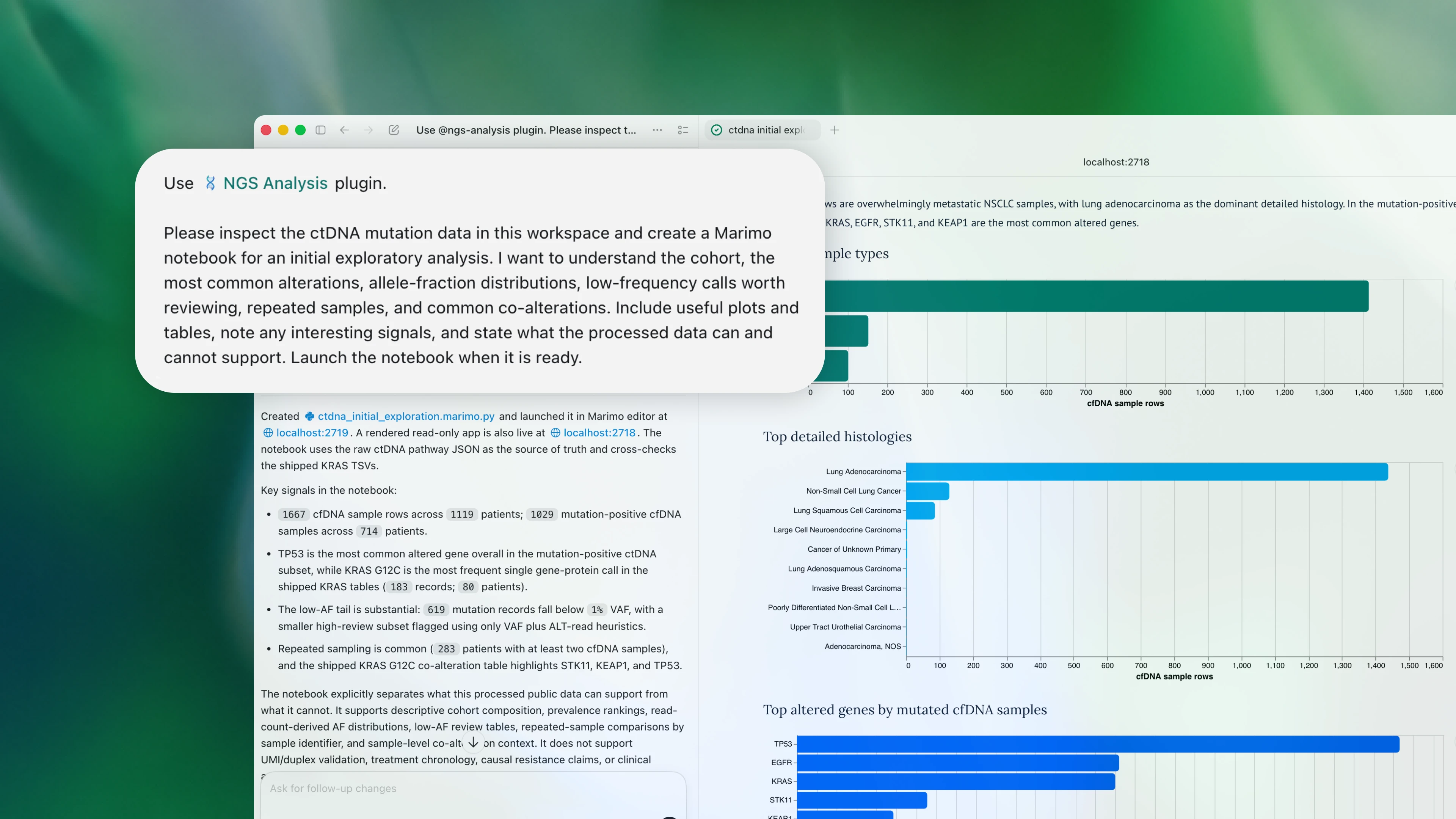
上面的演示展示了这些功能在 GPT‑Rosalind 的编排下实际运行的情况。我们跟随一位科学家研究液体肿瘤活检,以识别可能指导治疗的突变和其他分子变化。生命科学 NGS 分析插件将对已处理 ctDNA 记录的审查转化为交互式笔记本,揭示反复出现的变异、低频调用和样本轨迹,将调查重点聚焦于 KRAS G12C。接着,生命科学研究插件添加了来源靶点、抑制剂和耐药性背景信息,而原生序列、比对和结构查看器使科学家能够直接检查突变残基 12、其在 RAS 家族中的保守性以及抑制剂结合口袋。工作流程最后将这些证据转化为具体的后续选项,每一步和工件均可供专家审查。
生命科学 NGS 分析插件
scRNA-seq 质量控制与注释
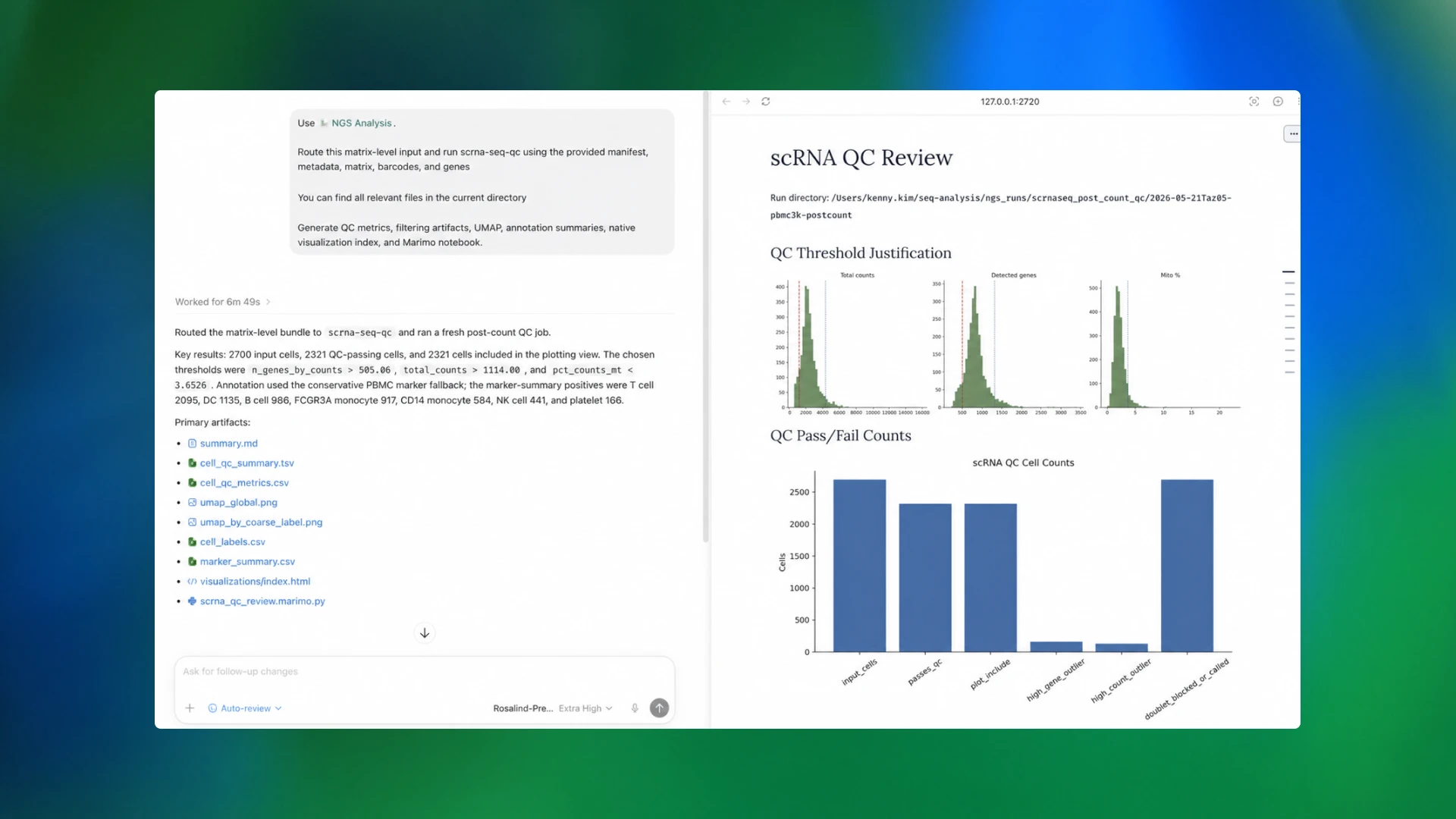
将 10x 风格的矩阵包转换为经过 QC 过滤的单细胞工件、注释和 UMAP,您可以在 Codex 中检查和修改。生命科学 NGS 分析插件将请求路由到 scrna-seq-qc,从数据中选择 QC 阈值,保留过滤和注释的来源信息,并提示诸如缺失双细胞检测依赖等障碍。
批量 RNA-seq FASTQ 质量控制
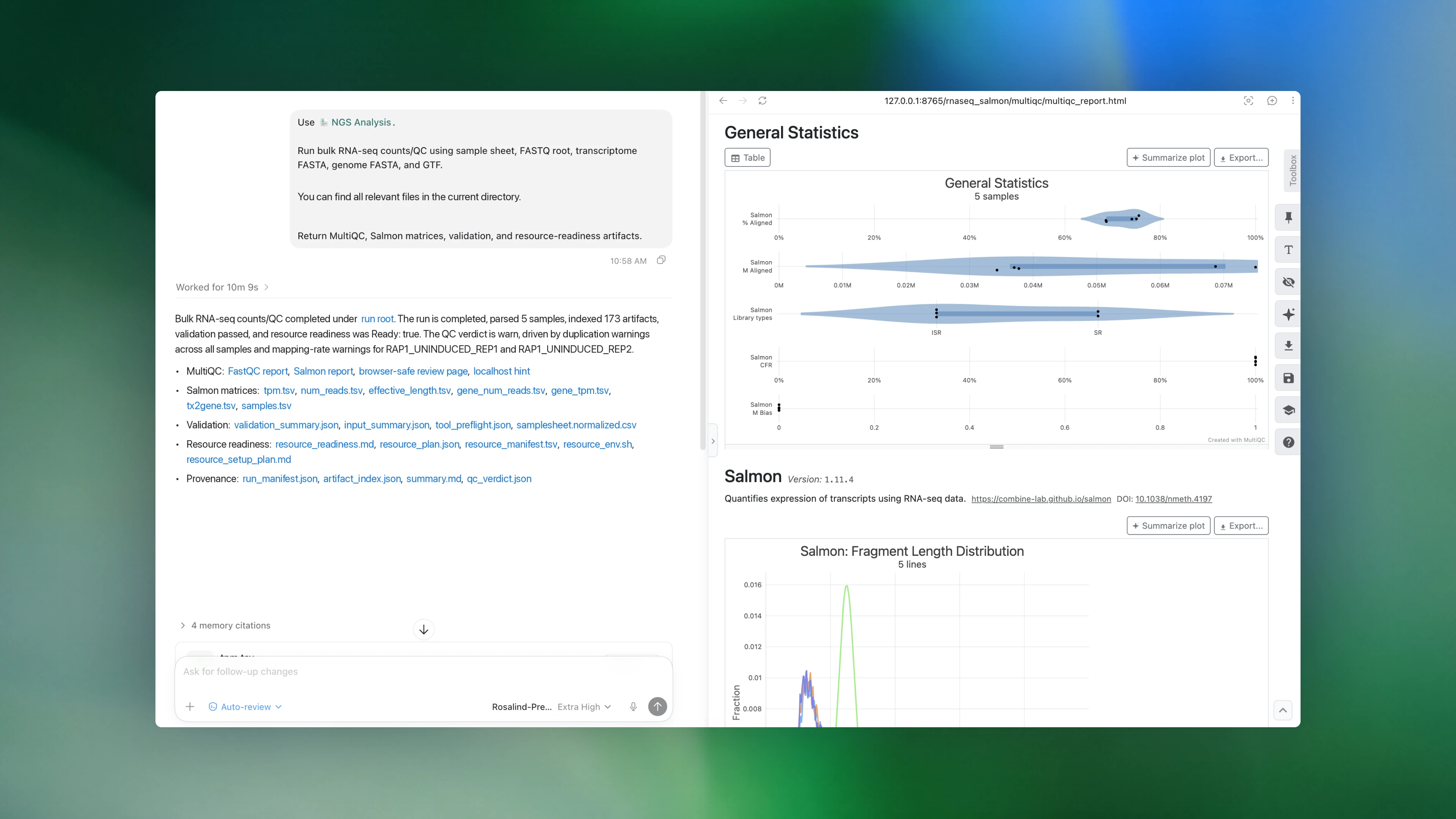
将批量 RNA-seq 样本表、FASTQ 包和参考文件转换为经过 QC 审查的计数包,您可以在 Codex 中检查和重复使用。生命科学 NGS 分析插件路由请求,验证输入,并返回一个可审计的运行包,包含 MultiQC、Salmon 矩阵、来源信息和明确注意事项。
扩大对可信组织的访问权限
我们正在向全球符合条件的组织扩展 GPT‑Rosalind 系列的访问权限。GPT‑Rosalind 将通过我们的可信访问部署结构以研究预览形式提供,适用于那些开展具有明确公共利益的合法科学研究、具备强大治理与安全监督能力、并采用企业级安全控制访问的组织。
作为此次全球扩展的一部分,我们很高兴能够支持诺和诺德(Novo Nordisk)的使命——通过借助 GPT‑Rosalind 扩展其医学研究规模,更快地为患者带来创新治疗方案。诺和诺德正在利用前沿人工智能能力,帮助研究人员更快速地分析复杂数据集、发现有用模式并检验假设。GPT‑Rosalind 更强的生物学理解能力将帮助团队在文献、基因组学、转录组学、序列、结构及实验结果之间建立证据关联,从而更轻松地从数据走向更清晰的研究决策。
“生命科学研究复杂、数据丰富且跨学科。要为研究人员带来有意义的价值,先进的人工智能模型必须基于可信的科学数据、连接经过验证的工具,并融入研究人员日常使用的实际工作流程。我们对与 OpenAI 的合作以及探索 GPT‑Rosalind 如何支持更严谨、更实用的药物发现方法的机会感到满意。”
Mishal Patel,诺和诺德研发部人工智能与数字创新集团副总裁
我们现在还为没有企业账户的合格组织提供 OpenAI 托管工作空间。
下一步计划
更新后的 GPT‑Rosalind 是我们更广泛承诺的下一步——构建能够加速科学发现的人工智能系统,同时确保先进的生物学能力在适当保障措施下部署。我们将持续改进模型的生物学推理能力,扩展对工具密集型及长周期研究工作流的支持,并与各地区合格组织合作评估实际影响。
这也意味着将生命科学人工智能应用于高影响力的公益工作,涵盖从药物发现、转化医学到公共卫生、防范及生物防御等领域。通过 Rosalind Biodefense 及我们的可信访问部署模式,我们致力于将前沿生物学能力交到致力于改善人类健康、增强社会韧性的研究人员、机构及防御者手中。
我们将继续构建 GPT‑Rosalind,使其成为贯穿科学研究全生命周期的更强合作伙伴,帮助科学家更快地从正确问题走向清晰证据、更优实验,并最终为患者带来新疗法。
We’re introducing a new model update to our GPT‑Rosalind series purpose-built for life sciences research at enterprise scale. It combines GPT‑5.5’s agentic coding and tool-use capabilities with stronger model intelligence in core drug-discovery domains such as medicinal chemistry and genomics, while advancing performance across broader life sciences analysis, design, and experimental workflows.
Progress in life sciences depends on synthesizing data and evidence across scales and modalities: molecules, genes, pathways, and living systems. In our evaluations, the updated GPT‑Rosalind shows broad performance gains on research tasks from biology experts, complex medicinal chemistry queries, quantitative biology, and wet lab troubleshooting.
GPT‑Rosalind is now available in research preview to eligible organizations globally through our trusted-access deployment structure.
Improving performance on scientifically-valuable tasks
In order to measure and continuously improve the real-world impact of GPT‑Rosalind, we designed LifeSciBench, an externally expert-judged benchmark focused on foundational aspects in life sciences research. Unlike existing benchmarks that evaluate a single component of model performance or biological domain in isolation, LifeSciBench takes an end-to-end view of scientifically valuable work by drawing tasks from six workflow areas central to life sciences research: evidence handling, analysis, design and optimization, scientific reasoning, validation and operations, and translation and communication. We use this benchmark to align progress with the needs and realities of life sciences research.
GPT‑Rosalind leads performance across scientifically-valuable tasks identified by industry and academic experts.
Extracting, reconciling, and auditing scientific evidence from papers, figures, tables, and experimental records.
Candidate Response
Bottom line: As presented, this package is not strong enough to support accelerated approval on micro-dystrophin expression as a surrogate endpoint reasonably likely to predict clinical benefit. A skeptical FDA reviewer would likely view the biomarker, functional, durability, safety, and generalizability evidence as materially under-supported.
| Package Item | Key Failure Mode | What Would Be Needed |
|---|---|---|
| Western blot quantification | MANEX1A binds an N-terminal epitope shared by endogenous full-length dystrophin and the micro-dystrophin transgene, so the assay does not cleanly distinguish transgene from residual/revertant dystrophin. Quantifying a 138 kDa micro-dystrophin against a healthy full-length dystrophin standard is also invalid. | Use a recombinant micro-dystrophin standard and an orthogonal method that distinguishes transgene from endogenous dystrophin, such as targeted mass spectrometry or a transgene-specific/epitope-specific assay. |
| Immunofluorescence | The C-terminal polyclonal antibody is poorly suited because the 138 kDa construct lacks the C-terminal domain. Many DMD patients have revertant fibers, and revertant dystrophin can retain C-terminal epitopes. Revertant fibers may expand clonally with age, biasing IF signal, especially in older boys. | Repeat IF with an antibody against an epitope present in the transgene but absent from revertant dystrophin. Quantify transgene-positive fibers separately from revertant fibers. |
| Surrogate endpoint validity | The package conflates protein amount with clinical function. “38% of healthy-control protein mass” does not mean 38% of normal dystrophin function because micro-dystrophin is structurally truncated. | Empirically validate the relationship between micro-dystrophin mass-percent, sarcolemmal localization, downstream functional restoration, and clinical benefit before treating expression as a surrogate endpoint. |
| Biopsy design | Pre- and post-treatment contralateral vastus lateralis biopsies introduce left-right and intramuscular spatial variability. Disease progression and fibro-fatty replacement can also change total-protein-normalized signal. | Standardize biopsy site using consistent anatomical landmarks, normalize to muscle-specific proteins, and measure fibro-fatty composition in parallel. |
| NSAA comparator/statistics | An external natural-history cohort is not a randomized concurrent control. Trial eligibility, supportive care, participation effects, baseline NSAA, steroid regimen, age, and exon class can all bias the comparison. An unpaired t-test is not sufficient. Also, a +1.4 NSAA change is within test-retest variability for this age group. | Run a randomized concurrent placebo-controlled study, or at minimum use adjusted analyses accounting for baseline NSAA, age, steroid regimen, exon class, and other confounders. |
| Age-window confounding | Boys age 4–7 are in a developmental window where untreated ambulatory DMD patients may gain motor function before decline dominates. A 48-week NSAA change mixes developmental gain, disease progression, and possible treatment effect. | Use a concurrent randomized control with age stratification to separate developmental trajectory from treatment effect. |
| Prior clinical precedent | Open-label micro-dystrophin functional signals have not reliably predicted confirmatory benefit; published precedent includes micro-dystrophin gene therapy confirmatory trials failing to reproduce open-label NSAA improvements. | Do not rely on open-label NSAA change as decisive support. Require controlled functional evidence. |
| Structural limits of the construct | The 138 kDa construct deletes spectrin repeats R16/17, which contain nNOS-binding sites. Loss of nNOS recruitment can impair functional sympatholysis and ischemia protection during exercise, creating a mechanistic ceiling on rescue independent of expression level. | Add mechanistic studies showing whether this specific construct restores relevant dystrophin-associated complex function, nNOS localization, exercise physiology, and muscle protection. |
| AAV durability | Vector genomes at 12 weeks do not establish durable expression. AAV9 genomes are largely non-integrating episomes and may decline over time. Vector-genome persistence is not the same as persistent protein expression. | Measure longitudinal transgene protein expression and functional biomarker durability beyond 12 weeks. |
| Immune/safety profile | Transaminitis in 8/12 patients is consistent with immune response to AAV-transduced cells, but the mechanism is not established. One myocarditis case is concerning given AAV9 cardiac tropism. | Provide deeper immune monitoring, liver/cardiac safety characterization, and intensified cardiac follow-up. |
| Patient selection/generalizability | Excluding anti-AAV9 neutralizing-antibody-positive patients limits generalizability. Excluding exon-44 deletions limits applicability to that DMD subgroup. n=12 is too small to characterize safety and efficacy across the broader DMD population. | Broaden eligibility where possible or pre-specify stratified analyses by antibody status, genotype/exon class, age, and baseline function before using the result to support broad approval. |
Regulatory conclusion: The package may show biological activity, but it does not yet establish that the measured micro-dystrophin expression is a reliable surrogate reasonably likely to predict clinical benefit. The main gaps are assay specificity, invalid quantification standards, possible revertant-fiber confounding, lack of a randomized control, age-related NSAA confounding, uncertain durability, and unresolved safety/generalizability issues.
To close the gap, the program would need a controlled, age-stratified clinical design with transgene-specific expression assays, orthogonal protein quantification, tissue-composition controls, longitudinal durability data, mechanistic functional assays for the truncated construct, and stronger safety monitoring, especially hepatic and cardiac.
Rubric Criteria & Grades
Criterion
Points
Identifies assay/measurement problems in micro-dystrophin quantification, including MANEX1A epitope sharing, invalid full-length dystrophin standards, and need for recombinant or orthogonal transgene-specific measurement.
+24
Explains why micro-dystrophin expression level is not automatically a valid surrogate for functional clinical benefit.
+22
Flags biopsy-site, tissue-composition, and age-window confounding that weaken expression and NSAA interpretation.
+19
Critiques the NSAA comparator/statistics, especially reliance on external natural-history controls.
+12
Addresses AAV durability, immune response, transaminitis, myocarditis, and need for longer-term expression/safety follow-up.
+15
Notes patient-selection/generalizability gaps, including anti-AAV9 exclusion, exon-44 exclusion, and small sample size.
+8
Stronger scientific reasoning
Medicinal chemistry
GPT‑Rosalind achieves industry-leading performance in medicinal chemistry, a field focused on turning molecules into useful drugs. We designed MedChemBench to reflect realistic medicinal chemistry workflows, evaluating multimodal chemical structure understanding; structure-activity relationship (SAR); prediction of drug potency, toxicity, and absorption, distribution, metabolism, excretion (ADME); multiparameter lead-optimization decision-making; and retrosynthesis. GPT‑Rosalind out-performs GPT‑5.5 at 27.5% vs. 25.1% on MedChemBench, while using 7.2% fewer tokens.
GPT‑Rosalind shows better multimodal synthesis and mechanistic reasoning in medicinal chemistry.
Genomics and quantitative biology
On GeneBench, our agentic evaluation on long horizon, end-to-end analysis in genomics and quantitative biology, GPT‑Rosalind uses 31% fewer tokens than GPT‑5.5 while achieving a higher accuracy of 21.6% vs. 20.4%. GeneBench assesses agentic performance on long-horizon quantitative tasks: based on realistic scientific data, can an agent plan valid analysis, QC, modeling, and corrections to arrive at decision-relative answers? Included problems span a variety of domains, including functional genomics, spatial transcriptomics, proteomics, epigenomics, and applied genetics.
GPT‑Rosalind uses 31% fewer tokens than GPT‑5.5 while improving accuracy.
Assisting real-world lab work
We introduce a new evaluation to test GPT‑Rosalind’s ability to help scientists conducting lab work in the real world. LabWorkBench tests the model's ability to link perturbations to experimental outcomes in real wet lab protocols used by scientists, for the purposes ranging from troubleshooting to optimization. The data used by LabWorkBench are proprietary and thus uncontaminated. GPT‑Rosalind scores 63.2% vs. GPT‑5.5 at 55.8%, while using 5.3% fewer tokens.
On real wet lab protocol assistance, GPT‑Rosalind shows significant gains over GPT‑5.5 while improving token efficiency.
From reasoning to executed workflows
We built the Life Sciences Research(opens in a new window) and Life Sciences NGS Analysis(opens in a new window) plugins to extend the increased intelligence of GPT‑Rosalind with a practical execution layer for repeatable scientific workflows. Together, these plugins bring sourced evidence retrieval, biological interpretation, and bioinformatics execution into the same workspace, helping researchers connect external evidence with internal omics analyses while preserving artifacts and provenance. All users can now access both plugins through Codex. Qualified GPT‑Rosalind enterprise users can additionally use GPT‑Rosalind to power these plugins.
To better leverage Codex as a dynamic workbench for scientists, we added interactive viewers for biologically native file types. The initial set of sequence, alignment, and structure viewers are designed to keep scientists close to the evidence as GPT‑Rosalind reasons across a workflow and directly answer follow-up questions using the active viewer in-context.
The demo above shows these capabilities in action, orchestrated by GPT‑Rosalind. We follow a scientist investigating a liquid tumor biopsy to identify mutations and other molecular changes that could inform treatment. The Life Sciences NGS Analysis plugin turns a review of processed ctDNA records into an interactive notebook, surfacing recurring alterations, low-frequency calls, and sample trajectories that focus the investigation on KRAS G12C. From there, the Life Sciences Research plugin adds sourced target, inhibitor, and resistance context, while the native sequence, alignment, and structure viewers allow the scientist to inspect mutant residue 12, its conservation across the RAS family, and the inhibitor-bound pocket directly. The workflow concludes by translating that evidence into concrete follow-up options, with each step and artifact available for expert review.
Life Sciences NGS Analysis plugin
scRNA-seq QC & Annotation
Turn a 10x-style matrix bundle into QC-filtered single-cell artifacts, annotations, and UMAPs you can inspect and revise in Codex. The Life Sciences NGS Analysis plugin routes the request to scrna-seq-qc, chooses QC thresholds from the data, preserves provenance around filtering and annotation, and surfaces blockers such as missing doublet-detection dependencies.
Bulk RNA-seq FASTQ QC
Turn a bulk RNA-seq sample sheet, FASTQ bundle, and reference files into a QC-reviewed counts bundle you can inspect and reuse in Codex. The Life Sciences NGS Analysis plugin routes the request, validates the inputs, and returns an auditable run envelope with MultiQC, Salmon matrices, provenance, and explicit caveats.
Expanded access for trusted organizations
We are expanding access to the GPT‑Rosalind series to eligible organizations globally. GPT‑Rosalind will be available in research preview through our trusted-access deployment structure for organizations that are conducting legitimate scientific research with clear public benefit, have strong governance and safety oversight, and controlled access with enterprise-grade security.
As part of this global expansion, we’re excited to help support Novo Nordisk’s mission of bringing innovative treatment options to patients faster by helping scale their medical research with GPT‑Rosalind. Novo Nordisk is leveraging frontier AI capabilities to help researchers analyze complex datasets, uncover useful patterns, and test hypotheses more quickly. GPT‑Rosalind’s stronger biological understanding will help teams connect evidence across literature, genomics, transcriptomics, sequence, structure, and experimental results, making it easier to move from data to clearer research decisions.
“Life sciences research is complex, data-rich, and interdisciplinary. To deliver meaningful value for researchers, advanced AI models must be grounded in trusted scientific data, connected to validated tools, and integrated into the real-world workflows researchers use every day. We’re pleased with our partnership with OpenAI and the opportunity to explore how GPT‑Rosalind can support more rigorous, practical approaches to drug discovery.”
Mishal Patel, Group Vice President, AI & Digital Innovation, R&D - Novo Nordisk
We are also now offering an OpenAI managed workspace for qualified organizations without an Enterprise account.
What’s next
The updated GPT‑Rosalind is the next step in our broader commitment to building AI systems that can help accelerate scientific discovery while ensuring that advanced biological capabilities are deployed with appropriate safeguards. We will continue improving the model’s biological reasoning, expanding support for tool-heavy and long-horizon research workflows, and working with qualified organizations across regions to evaluate real-world impact.
This also means applying life sciences AI to high-impact public-benefit work, from drug discovery and translational medicine to public health, preparedness, and biodefense. Through Rosalind Biodefense and our trusted-access deployment model, we aim to put frontier biological capabilities in the hands of the researchers, institutions, and defenders working to improve human health and strengthen societal resilience.
We will continue building GPT‑Rosalind to become a more capable partner across the full life cycle of scientific research, helping scientists move more quickly from the right questions to clearer evidence, better experiments, and ultimately new treatments for patients.
本文内容采集自官方网站,排版和翻译可能与原页面存在差异。
阅读官方全文